Grown-Up Anger (2017)
The Connected Mysteries of Bob Dylan, Woody Guthrie, and the Calumet Massacre of 1913
by Daniel Wolff
Perusing the shelves of my favorite used book store, I spotted the familiar face of Woody Guthrie on the front cover of a dust jacket. The book promised to weave together a tale of fighting for economic justice through the history of Woody Guthrie and Bob Dylan. I was hooked. I didn't know much about Bob Dylan, but I'm a fan of Guthrie and I was excited to learn more. The book lived up to its promise and was a rather enjoyable read. It was really interesting to learn about how Bob Dylan looked up to Woody Guthrie as an idol, and how that image of his idol was shattered, leaving him to abandon his folk sound and beliefs. The way the author brought together these three different stories made for an engaging experience.
Project Hail Mary (2021)
by Andy Weir
Andy Weir's wonderfully humorous and nerdy prose once again blessed the pages with this brilliant book. I don't know what to lese to say; it deserves all the praise it gets. I can't wait to watch the movie.
Blame! (1998-2003)
by Tsutomu Nihei
Manga is not something I read a lot of. Other than Blame! I have only read the Neon Genesis Evangelion manga, both of which I have loved. The art and hellish sci-fi landscape of Blame! are what I think make it so good. The plot is enigmatic and scarcely explained, the characters rarely dialog, and the action takes place over almost incomprehensible distances and time. It's so fucking cool. I need to read more of his work.
The Starless Sea (2019)
by Erin Morgenstern
A story about Time and Fate, the Sun, the Moon, and the Stars, The Starless Sea is a novel that wraps around itself and unfurls as you read it. What it lacked in character development and plot, it made up for with its enchanting mysteries and fantastical setting. It was a beautiful read. It could, however, do without the occasional egregious harry potter references.
Service Model (2024)
by Adrian Tchaikovsky
A seemingly self-aware robot on the brink of sapience goes on an unwittingly protracted journey, when all he wants to do is go back to work. I loved this novel. The way Adrian Tchaikovsky writes from the robot’s perspective is insightful and unique. The robot goes through intriguing character development and we’re brought along to witness his programming attempt to cope with it. I am absolutely going to read more of Tchaikovsky’s work. My brother has read and recommended Shards of Earth so I'll likely start there.
A House With Good Bones (2023)
by T. Kingfisher
When it wasn't going down awkward attempts at quirky humor, A House With Good Bones was a decent suspenseful novel. There were even moments - especially during the ending - that were downright horrifying. Unfortunately, however, most of the book was uninteresting and poorly paced. The main character was obnoxiously oblivious to the obvious haunted events of the story - even when it was explicitly stated to her - until the very end, where she becomes the hero who saves everyone. The premise was really interesting and I think it could have been a good novel if it took itself seriously and was paced better, with a less obnoxious main character.
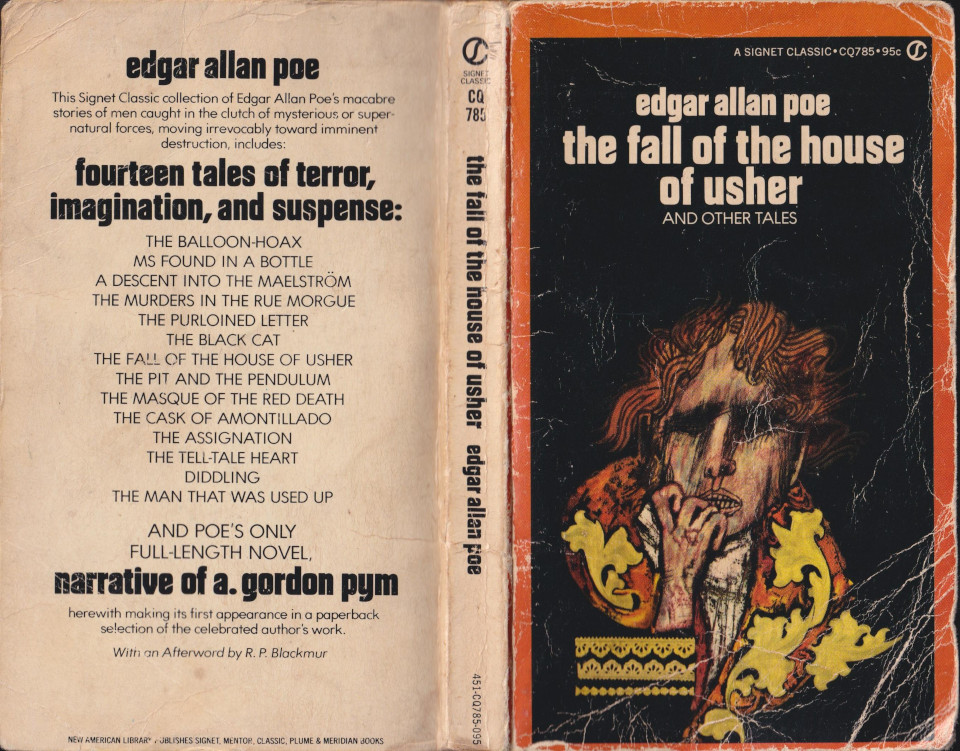
The Fall of the House of Usher and Other Tales
by Edgar Allan Poe
While perusing my favorite local, queer-owned used book shop I saw a discolored, musty, old paperback: a collection of Edgar Allan Poe stories. It promised "fourteen tales of terror, imagination, and suspense" including,
The Balloon-Hoax
MS. Found in a Bottle
A Descent into the Maelström
The Murders of the Rue Morgue
The Purloined Letter
The Black Cat
The Fall of the House of Usher
The Pit and the Pendulum
The Masque of the Red Death
The Cask of Amontillado
The Assignation
The Tell-Tale Heart
Diddling
The Man That Was Used Up
Narrative of A. Gordon Pym
I had never actually read any of Edgar Allan Poe's stories before, but I was very excited to finally read them. He has a reputation of having written short stories with dark themes, and I was looking forward to that. While there was, of course, plenty of that, I was surprised by the first story containing absolutely none of it. I still certainly enjoyed it, but I was caught off-guard. Many of the other stories obviously did not disappoint. especially "The Black Cat" and "The Fall of the House of Usher." In fact, after reading the former, I had to go cuddle with my own black cat and promise to never gouge his eyes out and hang him from a tree. I have also since purchased a book of Poe's poetry, which I am looking forward to.
Far from the gothic horror that I had associated Poe with, "The Balloon-Hoax" was something more like science-fiction. It was a somewhat fanciful tale of a lighter-than-air aircraft crossing the Atlantic Ocean. I assume from the way it was written that it was, as the title describes, actually printed as a hoax when it was first published, which is pretty interesting.
I found "MS. Found in a Bottle" to be a rather funny story, particularly because of the way it was framed. As the title suggests, the story is framed as a manuscript that was found in a bottle. The main character is writing down his experiences to put into said bottle. It was pretty funny to imagine this guy frantically writing as he's going through the events of the story, especially the ending, where he hurriedly writes as the ship he's on is sucked into a whirlpool.
"A Descent into the Maelström" is where it really started to get interesting. It was pretty exciting and I was a lot more into than the first two stories. The description of the Maelström was vivid and horrifying, and the sailor's disaster was utterly gripping.
"The Murders of the Rue Morgue" and "The Purloined Letter" were both pretty interesting, though I much preferred the first. The description of the murder was very gruesome, and the twist was very interesting.
"The Black Cat" was my absolute favorite of the bunch. It was incredibly fucked and dark, and I loved it. It was exactly the kind of story I was hoping for. It had me in the edge of my seat in disgust and horror. The main character is a man who was initially a gentle animal lover, who falls into alcoholism and enacts increasingly odious, vile, depraved violent acts on his pets and wife.
"The Fall of the House of Usher", the titular short story, was amazing. The imagery of the house, and surrounding land was eerie and compelling. The whole story had an enthralling atmosphere of dread.
I really enjoyed the slowly encroaching despair of "The Pit and the Pendulum". The torture of the main character as he sees his wicked demise slowly coming, was gripping and horrifying.
"The Masque of the Red Death" was a pretty interesting story. It wasn't as gripping or as horrifying as most of the other tales but it was an enjoyable read. It seemed like a bit of a political commentary on privileged people attempting to insulate themselves from the horror of reality.
Amontillado! "The Cask of Amontillado" was a really fun one. The main character's deranged logic was fascinating and enjoyable to read.
"The Tell-Tale Heart" was as good as its popularity suggests. The utter insanity of the main character's deranged murder and subsequent confession was a spectacle to read.
"The Assignation", "Diddling", and "The Man That Was Used Up" were three stories that I didn't really care for. They had none of the horror or atmosphere that I enjoyed from the other stories. I suppose "The Assignation" was interesting, but still not my favorite.
Now, "The Narrative of A. Gordon Pym" was a great novel; I enjoyed it quite a lot. It creates am atmosphere of horror born out of the terrifying treachery of the unyielding sea, and the main character's equally unyielding desire for it. Arthur Pym's desire for adventure worked against his safety, causing him to bring about his own demise, and create tension and excitement as I read. I found the ending to be particularly interesting in its oddity and incompleteness. It left the story unfinished and open to interpretation. When I read it, I personally interpreted it as him and his companion meeting some sort of god-like figure at the south pole and being deemed worthy of surviving. I feel I should also make note of the racism in the novel. Poe's description of some of the characters, and the inhabitants of the islands at the end of the novel were very much racist and off-putting, and much of the story, especially the ending is a result of that racism. It's disappointing that an otherwise interesting book is sullied by this.
Amazing Worlds of Science Fiction and Science Fact (2025)
by Keith Cooper
What a fascinating book! I love science and science fiction, and this was an amazing blend of the two. Keith Cooper explores the scientific plausibility of many different sci-fi exoplanets, including some of my most favorite, and many more that I am now quite interested in reading. It was a wonderful read the entire way though. I highly recommend it to anyone who is a fan of science and science fiction.
Upright Women Wanted (2020)
by Sarah Gailey
Upright Women Wanted had a fun story with likable characters, but I wasn't all that into it. I found the story and themes to be somewhat shallow. It's pretty heavy about it's themes of not believing in propaganda and deprogramming yourself, which, honestly, is just such an obvious thing, that I found it to be off-putting-ly heavy handed. I've been doing that work since I was a child. Though, I guess maybe this book was intended for younger audiences? I'm not sure. Anyway. The setting and world-building where interesting and unique but somewhat nonsensical. I found it completely unbelievable that the Librarians could operate as a part of the fascist government while also being an extensive resistance movement. How could they possibly operate without being found out? It really took me out of the story at several moments, especially the ending. However, one part of the world-building I found particularly interesting was that despite the fact that the book takes place in the future, the characters use single-action firearms. It's a somewhat obvious choice due to the book being a western, but it made me think of the in-universe reasons as to why they would use such outdated weaponry. I believe the reason would be that the modern firearms and their ammunition would be rationed for the fascist government's war efforts. The characters mention how other resources like diesel are used exclusively for war, which is why the characters use horse-drawn wagons. It would make sense then, for resources like brass to also be rationed, and for people to use cap-and-ball blackpowder firearms which don't require brass. Overall, it was a fun book and I enjoyed it, but it honestly wasn't that great.
Set Boundaries, Find Peace (2021)
A Guide to Reclaiming Yourself
by Nedra Glover Tawwab
This was a great book about boundaries. It'll be April's book club book. In particular I appreciated the sections about self-boundaries and technology boundaries. I honestly have a lot of work to do on my self-boundaries. I somewhat contradictorily have the tendency to both overexert myself, doing more things than I'm capable of handing, and also opting out of doing things that I would like to do, because I'm too anxious about them. I really struggle with finding the balance between overextending myself and being overprotective of myself, giving into my anxious tendencies. I think this is something I'll have to continually grapple with for the rest of my life, as my disabilities aren't going anywhere. I've recently done a lot of work on my technology boundaries, and I can say that it has had a profoundly positive impact on my life. I'm a lot happier with how I spend my time, and the time I spend with myself is a lot happier. I'm really glad that Nedra Tawwab included technology boundaries in her book; it's a vital boundary that ought not be neglected. I'm looking forward to the book club discussion next month.
Giovanni's Room (1956)
by James Baldwin
A beautifully written tragic tale about gay life in 1950's Paris, Giovanni's Room was a book club pick for the LGBT book club I attend. While the main character is a detestable, tragically flawed man, James Baldwin's writing is beautiful and enrapturing; I found myself struggling to put the book down. I would absolutely love to read more of his work in the future.
Ghosted (2025)
A History of Ghost Hunting and Why We Keep Looking
by Alice Vernon
I don't believe in ghosts, but ever since I was a child I have had a fascination with and a fear of them. When I saw the spooky ethereal figure on the front cover of Ghosted, I was immediately drawn in and as soon as I read the inside of the dust jacket I was hooked. I just had to check it out and read it. And let me tell you: it did not disappoint. The history of ghost hunting is fascinating, and often just as ridiculous as contemporary ghost hunting. I somehow found myself believing in ghosts even less now than before I had read the book. Alice Vernon did an excellent job of putting the full history of ghost hunting into perspective in a way that demonstrates just how specious a ghostly life after death is. I highly recommend it to anyone interested.
The China Study: Revised and Expanded expedition (2005, revised 2016)
The Most Comprehensive Study of Nutrition Ever Conducted and the Startling Implications for Diet, Weight Loss, and Long-Term Health
by T. Colin Campbell, PhD
and Thomas M. Campbell, MD
The China Study is the most scientifically competent diet book ever written. In fact, it seems almost offensive to simply call it a "diet book", as it is so much more vital than what a diet book usually is. It would be better described as a review of the scientific literature on human diet and how it relates to health outcomes, and a scathing critique of the typical western diet and the institutions that have brought us such an insalubrious way of eating. Campbell goes point-by-point and study-by-study to explain how he came to the conclusion that a whole-foods plant-based diet is optimal for human health, and to dispel the pervasive misinformation regarding diet and health. Prior to reading this book I was already aware of many of the benefits of a WFPB diet, and have been more-or-less eating a WFPB diet for several years, but I still found plenty of new information. I also believe it's a good idea to read the books of the experts themselves, rather than rely on second-hand information. My biggest takeaways from the book are that I probably don't have to worry as much as I do about cancer, especially ones so dependent on diet like colon cancer, that the Corrupt Fucking Systems that brought us our standard diet are even worse than I thought, and man, I really need to do cardio. Campbell has other books on similar topics that I would love to check out from the library, and I would love to get a personal copy of The China Study eventually.
Atlas of the Heart (2021)
Mapping Meaningful Connection and the Language of Human Experience
by Brené Brown
Posted
A good primer on emotion, I found Atlas of the Heart lacking in the depth that I was hoping for. After reading Rising Strong, I had high hopes for Brené Brown's other books. While this was certainly a great book that was well researched, I was disappointed that it didn't go further in depth on each emotion. Each only got roughly a page on average. After finishing each section I found myself thinking "that's it?" and not getting much actionable information out of them, other than perhaps a deeper understanding of what each emotion is, but still not as deep of an understanding as I had hoped for. I found the lack of depth left me still not fully understanding what all the emotions were. I think I'll be doing further reading on separate emotions to develop a better understanding.
Aside from the shallow contents of the book, I found the formatting to be infuriatingly awful. Most of the pages are defaced with huge quotes (from the text of that page - which is a massive pet peeve of mine. I'm fucking reading that shit right now! Your giant quotes are naught but a fucking distraction!!) In even more egregious disgrace of book formatting, there are two full 2-page spreads that interrupt the middle of a sentence! I shall speak no more on this subject for I am getting emotionally heated, typing on my keyboard with undue force. So, in conclusion, Atlas of the Heart is a disappointing, at times infuriating, but still good book. I still have hope for her other books, so when I get the chance and feel like it, I'll probably be checking them out.
Tonguebreaker (2019) Poems and Performance Texts
by Leah Lakshmi Piepzna-Samarasinha
Posted
Tonguebreaker is not a book I would have pick up for myself; the type of poetry that Leah Lakshmi Piepzna-Samarasinha writes in it is out of my scope of poetry that I typically enjoy. I tend to enjoy poetry that makes heavy use of imagery. I also really enjoy rhyme and meter; they both feel great to read, both on the tongue and in the mind. But I suppose that Tonguebreaker wouldn't be true to it's name if the poems where so pleasant on the tongue. I read it because it is March's book for the LGBT book club that I attend at my local LGBT center. I am so grateful for this book book club because it has exposed me to many new books, genres, and such that I would have otherwise never picked up and enjoyed. Indeed, I actually quite enjoyed this book. However, as I read the first poem, I thought I was going to be in for a long, rough ride when I saw just how scarce imagery and rhyme are used; but as I kept reading I found enjoyment in their poems for reasons other than my above-mentioned typical reasons. I found the themes of the poems to be so meaningful, important, and powerful that I kept reading and enjoyed the poems for what they were: thoughts, feelings, experiences, lives distilled down into an art of words. I consider this to be a pretty profound break-through moment on my understanding of poetry. I now understand why people enjoy poetry like this and I understand it's importance much more now. It even inspired me to write a poem of my own titled "Finding Human Soul in the Free Verse". Though I do appreciate it for what it is, It's still not my preferred type of poetry.
What is a poem
With no rhyme, no meter, no imagery?
Is it simply
A pretentious sentence broken into fancy lines to look artsy?
Or is there more?
Does it open a door
To something deeper, the human soul,
The need to create, to communicate?
There are words with too much power
To be hidden at this hour
Amid sentences, paragraphs, essays, and fodder.
They must be bared naked - raw human soul upon that paper.
The Let Them Theory (2024) A Life-Changing Tool That Millions of People Can't Stop Talking About
by Mel Robbins
Posted
Another "Amazing Minds" book club book. This one, however, was far from amazing. If you couldn't already tell from the book's obnoxious subtitle, it's entirely too full of itself. It seems geared towards bratty assholes who live miserable lives and don't know how to interact with their fellow humans. The problems it seeks to solve seem so common sense and simple, that if one has not already figured them out, they must be leading an immensely misanthropic life. There are perhaps a few things in the book that aren't so pointless, such as the advice she gives on how to talk to people who are struggling to make positive changes in their life, however, I'm quite certain there are better sources for such information, as she simply quotes experts on the topic. Additionally, The Let Them Theory seems less like a theory, and far more like a marketing term that has been shoehorned into places it simply does not fit. There is no main premise that follows through the arguments in the book. Each section of the book is disjointed, giving separate life advice, with the words "let them" thrown in for flavor. The librarian who selected the book for the book club seemed pretty excited for it, so I feel slightly bad for tearing it apart so much in this review, but hopefully my negative thoughts regarding it should make for an interesting discussion.
Added
Somehow I forgot to complain about the worst part of this book! Lemme change that real quick >:) When talking about how to "help" loved ones struggling with addiction, she advocates to cut people off financially and to kick them out of the house. She says that this is because people aren't able to recover unless they hit "rock bottom". As if this stance wasn't bad enough on its own, when she talks about how to help people with other mental health disorders, such as depression she advocates for actually helping the person, doing things for them, and creating a healing space for them so they can recover in their own time. These hypocritical stances are a blatant, repugnant examples of stigmatization of substance abuse disorders over other mental health disorders. If you would help a loved one when they're struggling with a mental health disorder like depression, but would cut them off when they struggle with one like addiction, it isn't about doing what's best for them, it's about stigmatizing one over the other. Additionally, substance abuse disorders often go hand-in-hand with other disorders like depression. Treating addiction like it's some shameful moral failing is an incredibly damaging practice that undermines any pro-mental health stance. Fuck this book. Do better Mel Robbins.
Manifesto of the Communist Party (1848)
by Karl Marx and Fredrick Engels
Posted
It's kind of embarrassing to admit that I hadn't read the Communist Manifesto until so recently, however my introduction to leftist politics started with anarchism, reading The Conquest of Bread by Peter Kropotkin. I'm not really sure what to say about the Communist Manifesto; nothing in it was new to me. I've read about everything it goes over, just from different sources. I'm not even sure I'd recommend it to someone who wants to learn about communism because there are so many more modern resources that are easier to digest. Obviously, it's a historically important text that any leftist ought to read, but I have nothing to say about it that hasn't been said thousands of times before. The specific version I read is this version from the Marxists Internet Archive.
Added
A few days after posting this review I came to the realization that it was rather stupid of me to post a book review without giving any specific thoughts about the book, so I'm going to rectify that with this paragraph. To clarify: I am not a Marxist. I believe the goals laid out in the Manifesto are outdated and not applicable to our modern society of deeply entrenched capitalism. A communist revolution through governmental power is not feasible in a society with next to no working class solidarity. Most Americans are so indoctrinated into the capitalist mindset that to them, communism is equatable to oppression and authoritarianism. I believe the modern leftist's goal should be chiefly to create structures of mutual aid and to work towards building class solidarity. Serious change is scarcely possible in such a deeply fragmented society.
How to Read Novels Like a Professor (2008) A Jaunty Exploration of the World's Favorite Literary Form
by Thomas C. Foster
Posted
This was certainly not one of my favorite books, but I found the information in it to be pretty interesting. My biggest gripe with the book is that Foster's writing style was off-putting. I just didn't enjoy reading it. I'm unsure of what it was about it that I so disliked but I found it hard to follow, sort of all over the place. Most of the things he touched on felt a lot like a rehashing of what I learned in highschool, but I found his idea of reading a novel as a creative endeavour of the reader, to be a rather interesting idea. It would explain why I find reading a novel to be a far more engaging activity that I find watching a movie, or reading a comic or manga. I'm glad I read the book but I don't think I'll be looking to read more of his work.
This is Vegan Propaganda (2022) And Other Lies the Meat Industry Tells You
by Ed Winters
Posted
When I used to spend a lot of time watching YouTube, one of the people I liked to watch was Ed Winters on his channel Earthling Ed. His way with words and his ability to talk to people is as beautiful and inspiring as he is. While at the library my partner spotted this book in the "new non-fiction" section and pointed it out to me. I was excited when I recognized the name and checked it out right away. While reading this book it became immediately apparent to me that Ed Winters's elegance is speech carries very well to his writing. That is to say, this is a wonderfully well written book. He makes clear, concise, logical, meaningful arguments on almost every single topic related to veganism. This is Vegan Propaganda is one of, if not the go-to compendium of vegan knowledge. I would wholeheartedly recommend it to anyone with interest in veganism.
Anathema! (1983) Medieval Scribes and the History of Book Curses
by Marc Drogin
Posted
Anathema! was a book that Caminus recommended in their page about bookplates and book curses. The idea seemed quite interesting to me and I love old shit so I quickly downloaded the pdf of the e-book and transferred it to my tablet to read. Also, while on the topic of bookplates, I found a couple of really cute cat bookplates, as well as a really bad-ass one that I plan to use for myself. I found the history of scribes, books, and of course book curses to really interesting! After reading about the great care and reverence medieval people had for their precious books I have been handling mine with even more care, taking the effort to hold them gently and without touching the text. It makes me really appreciate the gift that books truly are. I also felt inspired to write a book curse of my own:
Lay a hand upon my page:
Be damned to eternal age
Burning in the pits of hell.
Upon my curse, you befell.
You have made your decision.
You have sealed your perdition!
Blue Horses (2014)
by Mary Oliver
Posted
A poet must read plenty of poetry to be proficient in their craft, and I must admit I have not read much poetry in my life, and I am most certainly not proficient in my craft. I found many of Mary Oliver's poems in this book to be quite beautiful. I especially loved her profound adoration of nature, which she has the poetic skill to describe it in ways I could only hope of.
Frankenstein (1818, revised 1831)
by Mary Shelley
Posted
Despite being a classic of gothic, and indeed mainstream media, I knew next to nothing of Frankenstein before reading it. I have not even watched any of the plethora of films inspired by the novel. Mary Shelley's masterful writing immediately enraptured me and this book quickly became my favorite of all time. I took my time while reading this novel and read through it very slowly, as to savor each sentence. It's an almost disappointingly short book and I wanted to get everything I could out of it. I made alacritous use of my newly-acquired dictionary while reading to fully understand any new words (and there were a lot) that I had encountered. I found the framing of the story as being told through the letters of a sailor who met Victor Frankenstein on an expedition to the north pole to be intriguing, especially as I have recently read multiple books where such expeditions are mentioned. It's very interesting to think about what it would have been like to live in a time where our very own planet's poles were yet unknown, and the wonder it must predispose one to. Mary Shelley has a few other novels I would like to eventually read, and I also think it would be interesting to read the original 1818 text of Frankenstein.
The Martian (2014)
by Andy Weir
Posted
For a long time science-fiction, especially hard sci-fi was my favorite book genre. I am a nerd at heart and I love when authors get nerdy. Though recently I have become interested in more historical literature and have become infatuated with the elegant prose of authors like Mary Shelley. Andy Weir's style and the narration of his character Mark Watney are a far cry from my new obsession but are still very skillfully and entertainingly done. The thrilling story had me gripped for hours on end I and I completed the novel in just over two sittings. It took me a while to warm up to the main character's humorous narration but once I did there were many times where I was laughing aloud to the book. I borrowed this book from my brother as well as Weir's other novel, Project Hail Mary, which I am excited to read. I originally heard of The Martian when the movie came out to much popularity. I don't watch movies very often, and as such I have not seen it yet, but now that I have so thoroughly enjoyed the book I plan on watching it at some point.
The Martians (2025) The True Story of an Alien Craze that Captured Turn-of-the-Century America
by David Baron
Posted
The Martians was a wonderfully written and well researched book about a spectacular story of pseudo-scientific speculation. The main character - or rather, historical figure - of the book, Percival Lowell, is an archetype all too familiar to us in the modern world: a rich man, with an obstinately held pseudo-scientific belief who uses his fortunes to pursue, and to persuade the public of. I saw this book sitting on the "new non-fiction" table at the library, and as a bit of a nerd it caught my attention. I was immediately interested in the information of the historical astronomy, as I find it immensely intriguing, but what ended up interesting me the most during my reading was the all too apparent similarities to modern-day pseudo-science. It turns out that rich men with far too much influence have been negatively affecting public perception of science for centuries. I earnestly enjoyed this book and I hope to read some more of David Baron's other books in the future.
Rising Strong (2015) The Reckoning. The Rumble. The Revolution.
by Brené Brown
Posted
Book clubs! I love book clubs! My local library has a book club I've started attending called "Amazing Minds" where we read and discuss self-help and similar sorts of books. February's book was Rising Strong by Brené Brown. This book was great. My initial impression was that the methods she describes are very similar to how I work through things in therapy. You see, the premise of the book is to give a formula for how to recover from failure, difficulties, fights, and such. The fact that I've used similar methods to recover from rather severe problems through therapy gave, in my mind, much credence to her methods. I have already started implementing some of her methods in order to deal with things in my life and I find them to be very valuable. Two particular ones that I have been using and finding success with are the use of the phrase "I'm making up the story" and the use of the "shitty first draft" when making sense of a difficult situation and the emotions and stories that come along with it. When I journal or talk to my partner about my feelings, and what I'm thinking about something that is particularly difficult, I use some sort of variation of the phrase "I'm making up the story that [blah blah blah...]." I find it to be a very helpful reminder that what I'm feeling and telling myself is not necessarily, and is likely not, the truth. It keeps my negative thoughts, anxiety spirals, and bad decisions in check. I have already been utilizing the "shitty first draft" technique for many years in the form of journaling but I have found that giving it this name has added even more effectiveness to it. I'm able to visualize the stories that I'm telling myself as if they are the first draft of a project, such as a poem or a 3d model. I can visualize myself striking out words and lines and writing new, better, more true ones, or I can visualize myself refining, reshaping, and making a more detailed 3d model. I find this visualization to be a very powerful tool to compare the process of dealing with emotions and difficulties to. There are certainly many more similarly helpful processes in the book, but I will leave those to Brené Brown to describe to you when you read the book for yourself. If you're at all interested in this book, absolutely give it a read. I'm certainly planning on reading more of her work in the future.

_of_Babette,1399526.jpg)
